Channel K01 · 2026
Regie
Live demo · built on my own initiative
Every AI action recorded in a ledger, and carried out only after your approval.
Try live (in Dutch)
In short
- Built for
- Businesses that want to use AI employees but keep control
- The problem
- You do not let an AI answer customers on its own without seeing what it does
- What it delivers
- What the AI may do on its own is set per type of task; the rest waits for your approval. Every step goes into a log that can only grow, with the hash of the previous entry. Try it live.
Overview
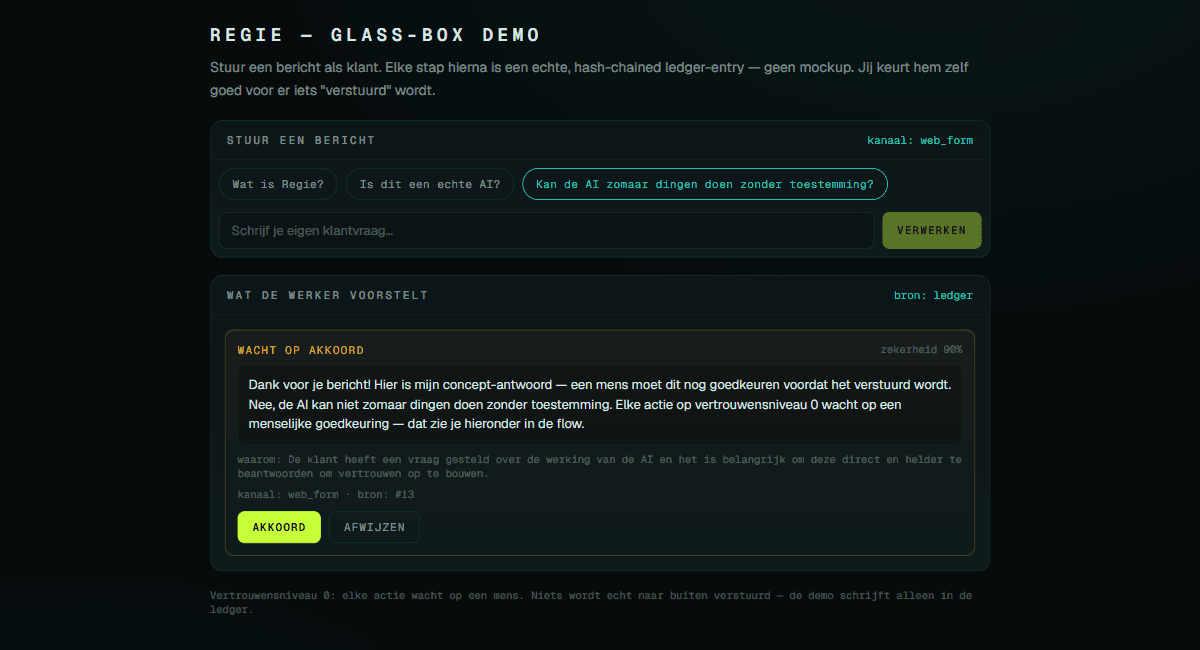
Regie is a control room for a business's AI employees. The AI proposes replies and actions, and everything it sees, proposes and does goes, with a reason in plain language, into a log. Try it yourself: send a message as a customer, then approve the draft reply as the business owner.

Challenge
AI agents that take action on their own sound powerful, but without a traceable record no business owner dares let them loose on customers. "Just trust the AI" is not a strategy.
What it does
- 01Receive
Every message arrives in one place, whatever the channel
- 02Propose
The AI proposes a reply and says why and how sure it is
- 03Approve
If the system is in doubt, it waits for you: visible, not hidden
- 04Execute
Only after your approval does it really happen, and it is recorded as evidence
Result
- What the AI may do on its own is set per type of task; in the demo, everything waits for your approval
- Every proposal and every action is in a log, with the reason and the confidence score
- A proposal can be approved or rejected only once, and a rejection carries out nothing
- Try it live: send a message yourself and approve it
Technology
A hash-chained Action Ledger records every observation, every proposal and every action; each entry holds the hash of the previous one, and the database refuses to change or delete entries. Each action type has an autonomy level. If that level or the confidence is too low, the system waits for human approval; in the demo, every proposal waits. A proposal that waits too long expires. You mark a carried-out action as reverted, with a reason; the original stays. A halt button immediately stops new follow-ups, scheduled actions and the approval of proposals that were already waiting, and records the halt in the ledger. A changed entry shows up on verification, and anyone who keeps a signed checkpoint of the demo will also see it if the log is fully rewritten later.